

Mindful Muster in May: your guided tour of the day
Coming Home to Country: A Day at the Mindful Muster
Taroona Primary School, Saturday 2 May 2026
There is something particular about driving south through Hobart on a Saturday morning when the air is sharp and clear, with a wide blue sky and wide Derwent river drawing your attention to a natural open awareness! That was the feeling as people made their way to Taroona Primary School on the 2nd of May for the Autumn Mindful Muster: a statewide six-hour retreat hosted by Mindfulness Programs Australia.
We gathered on Muwinina country — Tukirungipayna in Palawa Kani, the language of the Tasmanian Aboriginal people — part of the lutruwita/Tasmania, with the water in front of us and the mountain at our back. We arrived, as the day would ask us to, with respect and gratitude.
The Mindful Muster began back in 2023 with a Big Day Out in Campbell Town — a chance to reunite, to discover that the practice you had been tending quietly at home was held in common by dozens of other Tasmanians across the island. That day was good enough that everyone wanted to do it again. And again. Now held twice yearly in regional areas — spring and autumn — the Muster has become its own kind of ritual: part reunion, part retreat, part gentle reminder that community is also a practice.
Arriving: Setting Intentions
By ten o’clock the hall at Taroona PS was alive with the quiet warmth of people who know one another through something shared and hard to name. The stage had been dressed with foliage, rocks and shells — a little altar to the natural world just outside the windows. Teachers Josef, Edward, Larissa, Sharon, and Tracy gathered the group, the Bell of Mindfulness was introduced as the day’s punctuation mark — pause, and three breaths whenever you hear it — and housekeeping was gently attended to.
Then came the first invitation of the day: to choose an intention. Spread across the long tables were coloured tags — red for skills, orange for attitudes, yellow for the Five Factor qualities of mindfulness, green for themes gathered over the years from graduates, blue for anything else you wanted to name. You chose one, tucked it somewhere on your person, and carried it as a companion through everything that followed. It was a small act, but the specificity of it — the choosing, the physical tuck of a tag into a pocket — had the quality of a genuine commitment.
Sharon led the group through a movement-to-stillness practice: the body arriving before the mind catches up, the gradual quieting of the week just past. By the time it was done, the hall had changed register entirely.
Into Country: The Mindful Nature Walk
The walk was the heart of the morning, and it unfolded in five movements — each with its own quality of attention, its own invitation into the present.
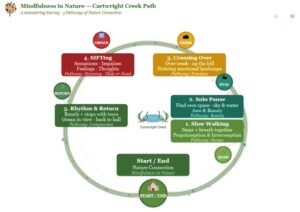
It began slowly: a crossing of the quadrangle together, step and breath synchronised, awareness dropping into the body — proprioception, interoception, the simple fact of feet on ground. Then, through the gate, the group dispersed. Each person found their own space on the oval and did something that is surprisingly hard to do in ordinary life: they lay down, or stood, or sat, and looked up. Wide sky watching. Clouds moved across a May sky that was doing what May skies in southern Tasmania do — shifting, theatrical, impossible to hold. The instruction was soft fascination, open awareness, a quality of attention that restores rather than depletes. Some people simply lay on the grass and let the vastness of the sky above Taroona do what it does.
Then came the challenge. The path led to the creek, and the creek required crossing — a moment of physical negotiation, of choosing your footing, of the small alertness that comes with not wanting to end up with wet boots. After the creek, the ground rose steeply. Going uphill is good mindfulness practice: the breath becomes unmissable, the legs register effort, the mind cannot drift far when the body is working. Emotion awareness, the field guide called it. The body knows things.
And then — the surprise. At the top of the path, a choice point. To one side: the slide. To the other: the road. It was not a metaphor, except that it was completely a metaphor. The instruction was to pause here, to SIFT — to notice Sensations, Images, Feelings and Thoughts — and to notice what arose at this junction between options. The slide, as it turned out, was taken by more than a few people with great seriousness and genuine delight. Something about the permission of it — the adult body on the school slide, the brief, uncomplicated joy of momentum — seemed to release something. Laughter drifted back down the path.
The walk home wove together trees and ocean views and the rhythm of steps with breath — a practice of compassion, the handout said, a returning. By the time the group came back through the hall door, something had shifted in the room. People were quieter in a different way than they had been quiet before. More settled. More themselves.
Stories the Land Carries: Nature Connection and Narrative Research
Back inside, the tables were rearranged into small groups for the morning’s second movement: a presentation and workshop from Dr Pauline Marsh, Senior Lecturer at UTAS in Health Geography and lead investigator on the Nature Connection and Storytelling Project.
The research Pauline described begins with a deceptively simple question: what is our relationship with nature, and does it matter for health and wellbeing? The answer, from the quantitative side, is measurable through tools like the Nature Connectedness Scale, and the data consistently shows links between connection to nature, wellbeing, and pro-environmental behaviours. But the research team wanted something more — something that could hold the texture of lived experience, that could carry the particular detail of what it actually feels like to be human in the natural world. So they opened a call for stories.
The stories came in different forms: reflections, life-writing, poetry, adventure tales, coming-of-age narratives. They were read closely for the elements of mindfulness they carried — openness, attention restoration, a sense of oneness with the natural world, moments of awe, transcendence, even sorrow. The rewards the stories described were never material, always internal: shifts toward peace, comfort, strength.
After the stories, people took up paper and pens and wrote in their journals — their own encounters with the natural world, what they noticed, what restored them, what they could not quite explain. Then the tables talked, and some people chose to share their stories with the UTAS research project. The morning had moved seamlessly from embodied experience on the creek path to the stories of others to the discovery of one’s own story. It felt intentional because it was.
If you’d like to contribute your story of mindful nature connection to the UTAS Storytelling project, you can do so here: https://thenatureconnectionproject.com.au/
The Long Table: Nourishing One Another
On the deck outside, the tables were pushed together into one long line, and the food came out.
This was a BYO shared lunch, and what that means in practice is a table covered in the particular generosity of people who cook for others with care: homemade things, beloved things, things that came with a story attached.
The questions Tracy invited at the table were not complicated but they were exactly right: Who might have made this? What is the story of this recipe? What do the smells and colours and textures offer you right now? What are you choosing to put on your plate, and what might that be saying about what you need today? Gratitude, sensory awareness, meaning-making — the same elements that had been practised all morning were still operating, now dressed up as lunch.
Ludovico Einaudi’s Experience played softly in the background, its piano line moving through the hall like a second thread of attention: unhurried, luminous, something that asked nothing of you except to let it in.
Water Under the Bridge: Nine Years of Evidence
After a concentration practice with Edward, the afternoon turned to data. Dr Larissa Bartlett, Research Fellow at the Menzies Institute for Medical Research at UTAS, and one of MPA’s teachers, presented early results from the Water Under the Bridge survey — a longitudinal study of people who had completed MPA’s mindfulness courses since 2016, now asking: does it last?
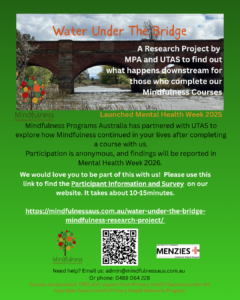
Seventy-nine people had provided full survey data by February 2026. The sample was 86% female, with an average age of 58, representing participants from every year of the program. They came in carrying questions about whether the effects of training hold over time — and the news, it turned out, was genuinely good.
Psychological distress, measured by the K10, averaged 19.6 in the sample — almost identical to post-course scores, and well down from the average pre-course score of 25. This suggests the reduction in distress achieved through training is being maintained, sometimes for years afterwards. Sixty-two percent of the sample were in the subclinical or mild distress range. Higher mindfulness predicted better health-related quality of life, with every point of increased mindfulness associated with measurable improvement across multiple dimensions of wellbeing.
The researchers had hypothesised that over time, practice would fade. It didn’t. Mindful walking, mindful listening, patience, non-judging and self-compassion all increased after training rather than declining. People who had done the more intensive courses — MBSR or MBCT — showed significantly higher mindfulness and lower distress than those in shorter programs. And people who had engaged with ongoing supports — practice groups, boosters, continuing courses — showed consistent benefit in both distress and mindfulness scores.
Then Tracy shared the emerging qualitative data. They described realising that a thought is just a thought — that if it is negative and makes them feel shame or anxiety, they can pull themselves up and question it. They described being so much kinder to themselves. One person wrote that the impact of mindfulness had been global, affecting every aspect of their life, so that no single aspect stood out. Another said it was the beginning of the journey to change my life.
Collective narratives made from the main themes were printed on cards and placed at the small group tables, where people were invited to reflect: What grabs your attention in this? What images come to mind? What resonates with your own experience? What might all of this make possible in the future — for you, for your community? Each table discussed them together, and shared their own reflections as well.
If you’d like to add your experiences with mindfulness to our research, we’d be very grateful! You can find the survey here: https://mindfulnessaus.com.au/water-under-the-bridge-mindfulness-research-project/
Closing: Basic Goodness
Josef led the final practice: awareness of breath opening into open awareness, with the theme of basic goodness — the idea, old in Buddhist psychology and newly confirmed in a great deal of neuroscience, that the ground of human experience is not damage but potential. A cultivation of metta, of loving-kindness, directed outward to the people sharing the hall and beyond.
Outside, the May light was doing something beautiful over the water at Taroona. Someone stood at the gate and looked at it for a moment before getting into the car. The slide was still there in the playground. The creek was still running. The sky was still wide.
About the Mindful Muster
The Mindful Muster is open to adults in Tasmania who have completed a Mindfulness Programs Australia course. Held twice yearly in regional locations, it is a six-hour retreat designed to deepen practice and build community. MPA programs are fully funded and free for people who meet the eligibility requirements, supported by Primary Health Tasmania under the Australian Government’s Primary Health Network program.
To find out more or to apply for a course: admin@mindfulnessaus.com.au | www.mindfulnessaus.com.au | 0488 064 228
Morning Meditation with Edward
If you were up early enough and with time on April 1st this year, you would have heard the dulcet tones of our teacher, Edward Croger, guiding us for our Morning Practice. Each month on the 1st morning, at 7am, the MPA community gather for a shared practice to refresh and reset at the beginning of the month. What we will try to do is record these as audio, and pop them in this blog, as well as on our socials, so you can practice ‘with’ us on all the other days of the month as well.
If this is useful for you, please let us know and we can find ways to bring more of our teachers guided practices to you!
Enjoy your morning (or whatever time of day you are reading this and using the recording!)
Tracy for the MPA team
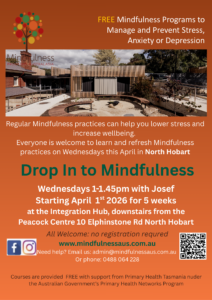
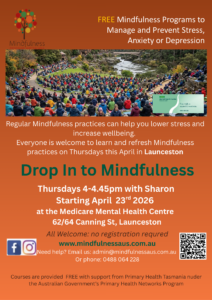
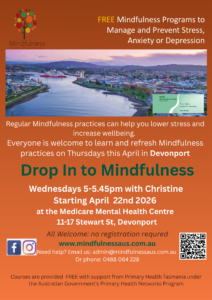
Drop In to Mindfulness this April!
We’re trying something new! 45 min Mindfulness Drop In sessions at the Integration Hub in Hobart, and the Medicare Mental Health Centres in Launceston and Devonport. We are hoping that these sessions with our teachers will be a way for folk to ‘check out’ mindfulness, enjoy some relaxation in their week, and for the old hands, be a chance to say hi to our teachers and have an opportunity to practice together again. All welcome, no experience needed, bring yourself and a friend as well and help make this experiment a success for us all! If you want to know more about what these sessions can bring, click Drop In info
Refreshed at Oura Oura
Being Refreshed at Oura Oura in the Liffey Valley Saturday 21st March meant having time and space to meander (pun intended) as we walked mindfully, giving ourselves permission to pause and inquire further when we noticed our attention being focused on a particular element.
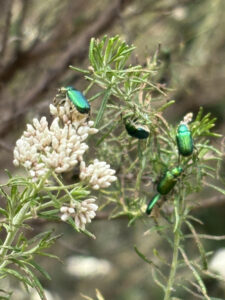
Walking in this way, we also explored touch through the bare soles of our feet (if we chose this) and our fingers, noticing the textures and the challenges of such intimate contact with the earth.
We wandered over the lawn shared by echindas, and up the start of the mountain track where the terrain became more challenging, and we noticed what this invited for us! Only one of us was bitten by an ant…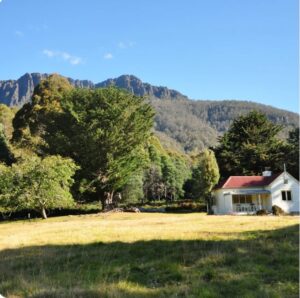
Our time for reflection explored just that: noticing what we noticed, and our response.
Later, at our sit spots, we noticed the living and non living beings that became present to us, noticing us in their home space. Metaphors emerged as we sat with our senses open, which become guides for us in our lives beyond the calm space Oura Oura provides.
Its not rocket science, this being mindful in nature. Our senses naturally open, and when we look up to see the wide horizon and expanse of the visual field, we naturally experience open awareness. Try it next time your in the wilderness, or maybe just standing outside your back door!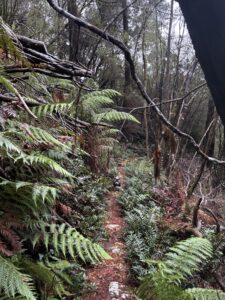
Bush Heritage Australia welcomed us, and continue to host visitors freely all year round. So if you haven’t been there yet, make sure this special place is on your bucket list.
Mindfulness Drop In Sessions in Devonport, Hobart and Launceston

We’re excited to announce free weekly mindfulness drop in sessions in Devonport and Hobart. These free sessions will provide mental fitness tune ups and a gentle workout for your mind. Just come as you are, and give it a go, no registration necessary.
Over 2000 Tasmanians have completed a Mindfulness Course with us, and we want to let you in on the secret, just 45mins per week. Learn mini practices that allow your Mind, Body and Thoughts to stay fit for life, able to meet challenges with confidence, and enjoy your life’s precious moments. Come along, learn a little, experience and practice Mindfulness, and reflect on what that was like for you, and what Mindfulness could make possible if you choose to keep it going in your life each day.
Mindfulness is an evidence-based set of skills to meet challenges more calmly, and get more joy out of life.Practices will be trauma-informed and inclusive of all particular life journeys such as gender diversity, cultural diversity, neurodiversity and age related experiences.
Details for the drop in sessions are below. Please note there is no registration required.
Devonport
Wednesdays 5-5.45pm with Christine
Starting April 22nd 2026
Medicare Mental Health Centre
11-17 Stewart St, Devonport
Download the Devonport Drop In flyer
Hobart
Wednesdays 1-1.45pm with Josef
Starting April 1st 2026 for 5 weeks
Peacock Centre, 10 Elphinstone Rd, North Hobart
Download the Hobart Drop In flyer
Launceston
Thursdays 4-4.45pm with Sharon
Starting April 23rd 2026
Medicare Mental Health Centre, 62/64 Canning St, Launceston
Download the Launceston Drop In flyer
Don’t hesitate to contact us if you have any questions or if you’d like to join our email list.
