
Water Under the Bridge is what we called our Researc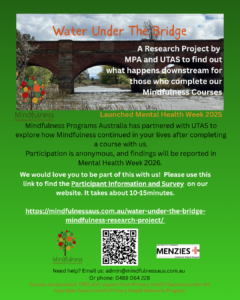 h project, because we want to know what happens ‘downstream’ after folk complete a Mindfulness course with us. Does Mindfulness continue to be helpful, and if so, how?
So we sent out a survey asking just that: how you feel now, which formal and informal practices you use, and what you’ve noticed about Mindfulness in your life.
And our interim findings are showing an exciting picture emerging, but we need more of you to complete the survey so we can be confident we’re hearing the right story.
Here’s some of what we’ve got so far:
Durable Wellbeing Gains People who completed mindfulness training reported higher mindfulness and better quality of life even years after training ended.
Practice Deepens over time How often graduates practised (formal and informal practices), their attitudes toward mindfulness, and their use of support resources all increased over time after completing training.
Intensive programs deliver more Participants in Mindfulness-Based Stress Reduction (MBSR) and Mindfulness-Based Cognitive Therapy (MBCT) reported stronger mindfulness outcomes than those in shorter or lower-intensity courses.
Ongoing Support Sustains gains Graduates who stayed connected to ongoing support — at least once after training — reported better mental health and quality of life than those who did not.
71% said they had a sustained personal mindfulness practice (formal and/or informal)
86% said they had better emotional regulation and stability
12% said they used mindfulness to cope with adversity and grief
45% said they experienced self-awareness and acceptance
44% said Mindfulness was helped by community and connection
32% said mindfulness helped to strengthen their relationships
Interim Results from Water Under the Bridge – Overall Collective Narrative Themes
Seventy-nine of us had responded to the Water Under the Bridge survey by February this year. Together, we described ways that we sustained our mindfulness practices, and noticed how we remained less reactive and more regulated. We described difficult times in our lives when mindfulness helped us cope, and even when it felt difficult, it helped us grow. We noticed we now ‘realise that a ‘thought is just a thought’ – if its negative and makes me feel shame or anxiety I can pull myself up and question it.’ For many of us, this has meant ‘being so much kinder to myself’. Although we didn’t always seek it out, being connected to others helped us keep practicing, but even without that, being grateful, having self compassion, less judgement and more patience has grown in us over time, along with becoming more mindful in our walking and relationships – some of us noticed how we had become better listeners! We felt that Mindfulness had helped to transform us. As one person said, ‘The impact has been global, affecting every aspect of my life, so no one aspect stands out.’
Interim Results from Water Under the Bridge – Q1
So how did Mindfulness stay present in our lives?
Many of us sit and breathe regularly, and do bodyscans. One of us had a streak of 620 days on Insight Timer! For others, Mindfulness showed up in our daily lives, like being ‘mindful of sights, sounds, eating, walking, in conversation.’ Some of us joined groups or attended mindfulness events and courses, and even when our practice was ‘up and down’, most of us were able to turn back to mindfulness practices when we needed them. And even if we didn’t, we noticed other benefits of mindfulness training.
Interim Results from Water Under the Bridge – Q2
So how did Mindfulness support us in difficult times?
Whether we were sick, grieving, stressed or traumatised, Mindfulness was there to calm, ground and de-escalate us. Some of us described ‘remembering to stop and breathe’ and ‘being able to problem solve’. When some of us had been in pain, mindfulness ‘changed how I responded to it’. When some experienced trauma, mindfulness helped keep focus. In grief, some of us could now ‘honour’ grief and ‘not try to fix’ others emotions. When caring for others, Mindfulness ‘helped me care…with kindness and generosity’.
Interim Results from Water Under the Bridge – Q3
Were there times Mindfulness was not helpful?
When we were asked this question, the vast majority of us turned it around and described all the positive effects instead! We said we were ‘less reactive’ and ‘didn’t believe all our thoughts!’ Some of us mentioned that its hard to find time for formal practice, and that practices can sometimes feel ‘painful’ and have strong difficult emotions present. Sometimes having been aware of our ‘busy mind’ led to frustration with ourselves, and being self deprecating.
Interim Results from Water Under the Bridge – Q4
What have been the best ways you kept mindfulness strong in your life?
This was a tricky one for most of us to answer: having improved relationships, feeling more confident and resilient, being more aware of ourselves in social interactions just seemed to naturally occur for many of us, without deliberate strategies. Some of us had sought out other mindfulness group activities like weekly practice groups and booster sessions, and we also used Apps and guided practices to support our own practices. Some of us built habits through our daily routines, like ‘breath watching’ and ‘bodyscan…has become a nightly ritual’, and ‘integrating with yoga, creativity and walking my dog’.
Interim Results from Water Under the Bridge – Q5
Have there been any negative impacts from Mindfulness?
Only about half of us even answered this question, and those that did reported ‘no negative impacts whatsoever!’ But a few of us did notice difficult memories and strong emotions ‘coming up’ during practice, which while unpleasant, also became opportunities for growth and processing: ‘The stirring up with new mindfulness skills has been both challenging, but beneficial’ one of us said. Being aware of self criticism, busy mind and unhelpful interpersonal patterns was described as ‘a blessing and a curse’ leading to an intention that ‘There needs to be a better balance’. Sometimes being less reactive felt awkward in conflicts with others, and could lead to avoiding touchy topics.
Interim Results from Water Under the Bridge – Q6
Is there anything else you’d like to tell us about your mindfulness experience?
Deep gratitude for Mindfulness came through strongly in our responses to the final question: grateful for the course, the way it was made free for the Tasmanian community, for the teachers’ care, and to MPA for delivering it all! Many of us wanted more ongoing group practices: online, face to face and at different times. We also wished that younger people could also learn these skills, and those in our society that struggle with violence, addiction and crime. Mindfulness courses were described as ‘the beginning of the journey’ to ‘change my life’ and have sustained improvement in wellbeing and quality of life.
Want to know more? Complete the Survey if you havent already HERE
And Stay tuned for the Conference Presentation we will post on this blog, which we are preparing for the International Mental Health Conference on the Gold Coast in June.
Tracy and the MPA/UTAS team!